How to Move Out of the US: A Family's Practical Guide (2026)
Healthcare costs, school safety, and a broken housing market are pushing Americans to look abroad. Here's where they're actually going - and why Panama keeps coming out on top.
It doesn't matter who you voted for. The people we speak to are leaving because the math of the American dream has fundamentally broken down. The average employer-sponsored family health insurance premium hit $26,993 in 2025. The median US home sale price sits over $400,000. And 2024 saw the second-highest number of school shootings since tracking began.
People aren't really leaving their country; they're leaving a system that keeps taking small pieces of them. Every new law that limits choice, every regulation that takes time, every tax that takes income - that's a chip off your life. A chip off the time you wanted with your family. A chip off the experiences you wanted to have. A chip off the freedom you thought adulthood would give you.
We're Australian. Different country, exact same pattern. We hit that wall in 2024, feeling the same pressures. We started researching how to move out of the US and other Western countries to find a different way. Here's what we figured out.
The Four Pressures Driving the American Exodus
1. The Healthcare Trap
The average employer-sponsored family health insurance premium hit $26,993 in 2025. Even with insurance, a single medical emergency can wipe out a decade of savings. Today, 66.5% of personal bankruptcies in the US cite medical bills as the primary cause. You are essentially one bad diagnosis away from losing everything you've built.
2. The Housing and Wage Squeeze
The median US home sale price sits over $400,000, with 30-year fixed mortgage rates hovering around 6.3%. Meanwhile, real wages have barely moved. Adjusted for inflation, today's average hourly wage has roughly the same purchasing power it did in 1978. You are working harder just to stand still.
3. School Safety
For families, this is the quiet terror that sits underneath everything else. 2024 saw the second-highest number of school shootings since tracking began. We speak to parents who are simply exhausted by the daily anxiety of dropping their kids off at the school gate.
4. The Fixed-Income Reality
For retirees, the math is brutal. The average monthly Social Security retirement benefit is $2,071. In most US cities, that barely covers rent, let alone food, utilities, and the healthcare costs that Medicare won't fully absorb.
Quick Comparison: Where Americans Are Moving
| Country | Monthly Cost (Family of 4) | Visa for Americans | Healthcare Quality | Homeschooling | Best For |
|---|---|---|---|---|---|
| 🇵🇦 Panama | $2,855–$4,148 USD | Friendly Nations / Pensionado | World-class (Private) | ✅ Legal | Tax efficiency & retirees |
| 🇵🇹 Portugal | $2,857–$3,148 USD | D7 / Digital Nomad | Excellent | ⚠️ Restricted | European access & safety |
| 🇪🇸 Spain | $3,225 USD | Non-Lucrative / Nomad | Excellent | ⚠️ Restricted | Culture & infrastructure |
| 🇲🇽 Mexico | $3,029 USD | Temporary Resident | Good (Private) | ✅ Legal | Proximity to US |
| 🇨🇷 Costa Rica | $3,572 USD | Rentista / Pensionado | Good (Private) | ❌ Illegal | Nature & established expats |
Country Deep Dives
🇵🇦 Panama
Panama is rapidly becoming a top choice for Americans, with over 25,000 US expats already living there. It operates on a territorial tax system, meaning foreign-sourced income is generally not taxed locally.
Cost Breakdown: For a family of four, monthly living costs range from $2,855 to $4,148 USD. Renting a 3-bedroom in Panama City averages $1,665–$2,151 USD, and in Boquete, furnished 3-bedroom houses run $800–$1,600 USD per month. Groceries run $400–$700 USD monthly, and private healthcare insurance starts around $22 USD per person for basic preventative care.
Visa Options: The Friendly Nations route may suit an eligible US national who can prove the current economic connection and meet the filing rules. For retirees, the Pensionado Visa is the gold standard globally: it requires a lifetime pension of just $1,000 USD per month and grants massive discounts on everything from healthcare to flights.
Running an online business? You don't need a Panama employer or $200,000 parked in a bank. You can incorporate your own Panama corporation (a Sociedad Anónima or LLC) and qualify through it. Most location-independent families take this path. We cover the mechanics in detail in Pathway to Panama.
Honest Downside: US citizens are taxed on worldwide income regardless of where they live. The Foreign Earned Income Exclusion (FEIE) allows you to exclude up to $126,500 USD of foreign-earned income from US taxes in 2024, but passive income and business income above the threshold still faces US tax. Proper tax planning is essential.
🇵🇹 Portugal
Cost Breakdown: Monthly costs for a family of four run $2,857–$3,148 USD.
Visa Options: The D7 Passive Income Visa and the Digital Nomad Visa are the most accessible routes. The D7 requires proof of passive income of at least €760 per month per adult.
Honest Downside: Portugal's NHR tax regime has been significantly reformed. The new IFICI regime is more restrictive. If tax efficiency is your primary driver, Portugal is no longer the obvious choice it once was.
🇪🇸 Spain
Cost Breakdown: Monthly costs for a family of four run around $3,225 USD in cities like Valencia or Málaga.
Visa Options: The Non-Lucrative Visa requires proof of passive income of around €2,400 per month. The Digital Nomad Visa requires a minimum income of €2,646 per month.
Honest Downside: Homeschooling is heavily restricted in Spain. Most regions require children to be enrolled in a registered school, which is a dealbreaker for many families.
🇲🇽 Mexico
Cost Breakdown: Monthly costs for a family of four run around $3,029 USD in popular expat destinations.
Visa Options: The Temporary Resident Visa requires proof of income of around $2,600 USD per month. After four years, you can apply for permanent residency.
Honest Downside: Security varies wildly by region. While expat hubs are generally safe, cartel violence in other states requires constant situational awareness.
🇨🇷 Costa Rica
Cost Breakdown: Costa Rica is the most expensive country in Central America. A family of four needs around $3,572 USD monthly.
Visa Options: The Rentista Visa requires proof of $2,500 USD monthly income for two years. The Pensionado route requires a qualifying lifetime pension of US$1,000 per month plus US$250 per dependent, subject to the current official requirements.
Honest Downside: Homeschooling is illegal in Costa Rica. All minors must attend an educational institution authorised by the Ministry of Public Education.
Why We Chose Panama
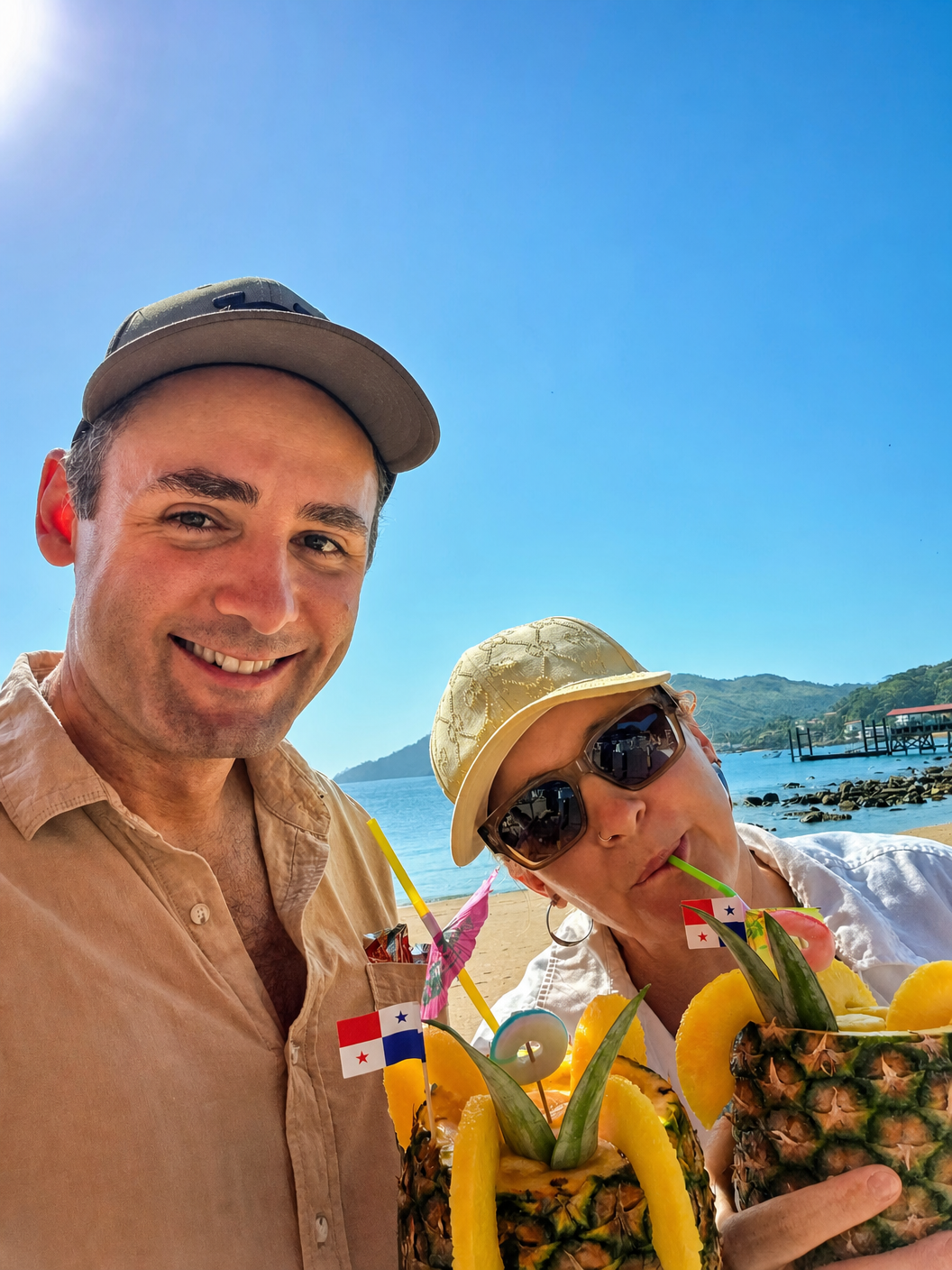
We literally had to Google Panama to work out where it was. We always thought we would settle in Europe, but the more we travelled there, the more we hit language barriers. We never felt anywhere that we could just relax and let go. We didn't want a place to retire. We are in build phase.
Panama was different. People come here not necessarily to become millionaires, but to create choice and opportunity at an affordable cost, while being a quick plane ride to America.
Since being in Panama, the high-level conversations we have had are incredible. We're not very good at small talk. Ask us about goals, dreams, or travel and we'll talk all day - but we'll also talk about bureaucracy, and Panama wins that comparison easily. It takes a very different group of people to surround yourself with that kind of mindset.
We meet Americans here every week who left for the same reasons. Some came for the tax structure. Some came for the Pensionado discounts. Some came because they couldn't watch their grandkids walk through metal detectors anymore. Whatever the trigger, they all say the same thing once they have been here a while: they wish they had done it sooner.
Ready to Explore Panama Deeper?
If you're that person that wants to create multiple sources of income, that wants to live a life of choice, and you're not scared of doing the work and recalibrating how you think, we built something for you.
Or, if you're on Instagram, comment PATHWAY on our latest post and we'll send the link straight to your DMs.
Frequently Asked Questions
Is it safe to raise kids in Panama?
Yes. Panama is consistently ranked as one of the safest countries in Latin America. For us, having an 18-year-old wanting to stretch his wings, safety was a massive factor. We feel significantly safer here than in many Western cities.
Can we homeschool our children in Panama?
Yes. Panama officially recognised homeschooling as a legal exemption to compulsory attendance in 2021. This was a non-negotiable for us, as many European countries strictly prohibit it.
How does the Pensionado Visa work?
It is arguably the best retirement visa in the world. You need proof of a lifetime monthly pension of at least $1,000 USD. Once approved, you receive permanent residency and massive discounts: 25% off flights, 50% off entertainment, and 15–20% off medical bills.
Do I have to pay US taxes on my Social Security in Panama?
Yes. Because of citizenship-based taxation, your US tax obligations remain. However, Panama will not tax your Social Security income, as it operates on a territorial tax system.